
NEWSLETTERS
How to Apply Waterproofing with Membrane?
Selecting membrane materials suitable for their intended application area and ensuring proper application are fundamental requirements for effective ground insulation. Before membrane application, surfaces must be thoroughly cleaned, and any issues that may hinder adhesion must be resolved. Any bumps or depressions such as mud, gravel, concrete, and stone on the ground should be removed as much as possible to create a flat surface. The ground should be free of pits and protrusions.
Concrete surfaces intended for application should not be wet or damp, and they should be allowed sufficient curing time. Additionally, not only the application surface but also the surrounding area should be cleared of factors like soil and mud.
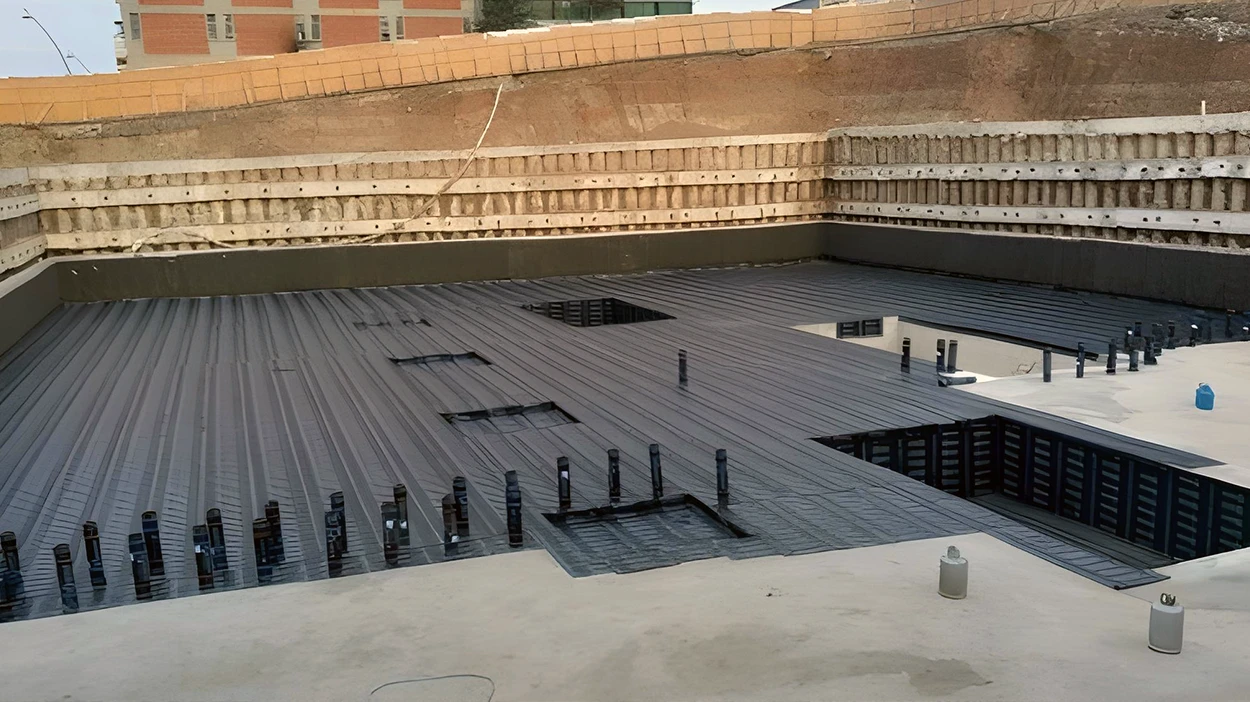
It is recommended to apply a bitumen-based primer to the ground first. The primer helps to minimize surface issues and increases the adhesion of the membrane to fully bonded surfaces. The membrane, provided in rolls, is unrolled and laid flat on the ground. A minimum overlap of 10 cm lengthwise and 15 cm at the seams should be left. Membranes should be aligned properly and laid so that they overlap. Seams are bonded using an LPG torch flame. The bitumen membrane, which melts like tar and adheres well to the ground, should be pressed with a spatula or trowel to secure it firmly.
For the first layer in foundational insulation, membranes are bonded only at the overlaps to ensure they are not affected by any deformation occurring between the low-dose lean concrete layer at the base of the structural foundation. If the application is to be performed on vertical surfaces in contact with soil, full adhesion on both layers of the membrane is required. Bonding at the overlaps occurs through heating with an LPG torch flame, which melts the modified bitumen (membrane). After bonding is complete, the melted bitumen should overflow at the overlap points, and this overflow (ensuring no exposure of the fiberglass or polyester mat) should be pressed with a spatula or trowel.
Around the roof perimeter, at the base of chimneys, or at roll heads, the membrane should be fully adhered over a minimum area of one meter. For slate-coated membranes, the side overlaps are bonded to 10 cm wide slate-free strips. At end overlaps, a 15 cm area should be heated, and the stones should be scraped off the surface with a trowel. For slate-coated products, it is recommended to spread slate granules over the molten bitumen before it cools. Overlaps should always be applied considering the direction of water flow, with membranes laid perpendicular to the water flow. The installation should always start from the lowest point.
For the second layer, the membrane layer should be fully adhered to the first layer with staggered overlaps. Both layers must be applied in the same direction, and a staggered layout should be avoided. Structure elements that penetrate the insulation must have flanges to allow for connection to the insulation.
Once the application is complete, it should be covered and protected to prevent tearing, punctures, aging (except for products with slate or laminated aluminum surfaces), and similar issues. The correct bonding temperature is achieved when the polyethylene film layer laminated on the membrane, sensitive to heat, melts upon contact with the torch flame. On sand-coated surfaces, the proper bonding temperature is indicated by a glossy appearance on the sand-coated surface when exposed to the torch flame.